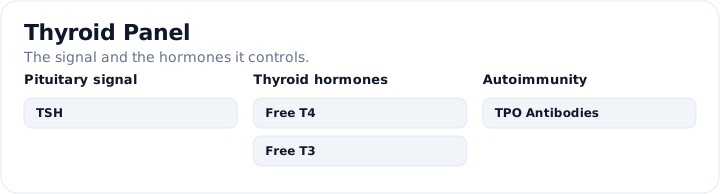
TSH is a pituitary signal, not a thyroid hormone. Here's what TSH, Free T4, and Free T3 each tell you — and why the borderline zone between 2.5 and 4.0 mIU/L is where most symptoms hide.
TSH is an indirect signal. It tells you what the pituitary is asking the thyroid to do — not what the thyroid is actually producing, or what your cells are using.
TSH (thyroid-stimulating hormone) is produced by the pituitary gland in the brain, not by the thyroid itself. When thyroid hormone levels fall, the pituitary raises TSH to push the thyroid to produce more. When levels are adequate, TSH drops back. This feedback loop means TSH is a second-order signal: by the time TSH rises past the lab's upper limit, the thyroid has typically been struggling for months.
A TSH of 3.5 mIU/L reads as "normal" on most lab reports. The ATA has debated lowering the upper normal limit to 2.5 mIU/L because patients with TSH between 2.5 and 4.0 mIU/L combined with low-normal Free T4 frequently present with fatigue, cold intolerance, brain fog, and hair thinning — and often respond to treatment. TSH alone doesn't capture the full picture.
The second gap: even when TSH and Free T4 are both normal, some people convert T4 to T3 poorly. Free T3 — the active hormone brain and muscle cells actually use — can be low-normal while the pituitary is satisfied. Standard thyroid panels that only measure TSH miss this entirely. A complete thyroid panel includes all three: TSH, Free T4, and Free T3.
Each marker answers a different question about where in the thyroid axis a problem originates.
TSH is the pituitary's instruction to the thyroid to produce more hormone. A high TSH means the pituitary is sending a strong demand signal — either because the thyroid is underperforming, or because thyroid hormone levels have fallen for another reason. A low TSH means the pituitary has backed off because thyroid hormone levels are high enough (or too high, as in hyperthyroidism).
The clinical debate is about the upper end of the range. Labs use 4.0–4.5 mIU/L as the cutoff. The ATA and many clinicians use 2.5 mIU/L as the functional upper limit in symptomatic patients — particularly women under 60 and anyone with TPO antibodies. A TSH of 3.2 mIU/L in a woman with fatigue, cold hands, and slow metabolism reads as "normal" on the lab report. Many clinicians would disagree.
The thyroid produces mostly T4. Free T4 (as opposed to total T4) measures the unbound, biologically available fraction. It reflects thyroid gland output directly. Low Free T4 with high TSH means the gland isn't keeping up with demand — the clearest biochemical picture of primary hypothyroidism.
Low-normal Free T4 (0.8–1.0 ng/dL) alongside a borderline-high TSH (2.5–4.0 mIU/L) is a pattern that most labs call "normal" but that frequently corresponds to clinical hypothyroid symptoms. The lab range includes the entire population distribution — not the range associated with optimal function. A value at the bottom of the range means the thyroid is producing at its minimum before TSH rises to flag it.
T4 is largely a storage form. Peripheral tissues — the liver, kidneys, muscles, and brain — convert T4 to T3 using enzymes called deiodinases. T3 is the hormone that enters cells and regulates metabolism, temperature, energy, and cognition. Free T3 measures the unbound, active fraction available for cellular use.
Some people convert T4 to T3 poorly. Causes include chronic stress (elevated cortisol suppresses conversion), caloric restriction, chronic illness, selenium deficiency, and genetic variation in deiodinase enzymes. The result: normal TSH, normal or low-normal Free T4, and low-normal Free T3 — with persistent fatigue, brain fog, and cold sensitivity that a standard TSH-only panel misses. This pattern is sometimes called peripheral conversion dysfunction or low T3 syndrome. Requesting Free T3 is the only way to detect it.
The standard lab range (0.4–4.0 mIU/L) captures the population distribution. The functional range for symptomatic patients is narrower.
| TSH value | Lab classification | Clinical interpretation |
|---|---|---|
| <0.1 mIU/LFlagged | Suppressed | Hyperthyroidism or over-treatment with thyroid medication. Free T3 and T4 needed to confirm and determine severity. |
| 0.1–0.4 mIU/LBorderline | Low-normal or subclinical hyperthyroid | Can indicate early hyperthyroidism, autonomous thyroid nodule, or over-replacement. Monitor with Free T3/T4 and symptoms. |
| 0.4–2.5 mIU/LOptimal | Normal | ATA-preferred functional zone. TSH in the lower half of the range alongside mid-range Free T4 and T3 is associated with good thyroid function. |
| 2.5–4.0 mIU/LBorderline | High-normal (lab says normal) | Lab reports this as normal. ATA debate has centred on whether 2.5 is a better upper limit in symptomatic patients. If you have fatigue, cold intolerance, or brain fog, request Free T3 and Free T4 — TSH alone is insufficient here. |
| 4.0–10.0 mIU/LFlagged | Subclinical hypothyroidism | TSH elevated, Free T4 still normal. The gland is working harder to maintain output. Treatment decisions depend on TSH level, symptoms, and TPO antibody status. Most guidelines treat above 10 mIU/L regardless of symptoms; 4–10 mIU/L requires clinical judgment. |
| >10.0 mIU/LFlagged | Overt or severe subclinical hypothyroidism | Strong signal of thyroid failure. Low Free T4 alongside TSH above 10 is overt hypothyroidism. Most guidelines recommend treatment at this level regardless of symptom severity. |
TSH: 1.8 mIU/L (normal). Free T4: 0.9 ng/dL (low-normal). Free T3: 2.4 pg/mL (low-normal). Lab printout: all within range. Patient: persistent fatigue, brain fog, cold hands, and slow metabolism. The pituitary is satisfied. The thyroid is producing at minimum. Peripheral conversion is poor. Standard TSH-only testing catches none of this — and the patient is told their thyroid is "fine."
TSH, Free T4, and Free T3 measure function. Antibodies identify whether an autoimmune process is driving that dysfunction.
TPO antibodies (anti-thyroid peroxidase) are the primary marker for Hashimoto's thyroiditis — the autoimmune attack on the thyroid enzyme that drives most cases of hypothyroidism in developed countries. Normal: below 35 IU/mL (most labs). Elevated TPO antibodies with borderline TSH and symptoms is an actionable finding even when TSH hasn't crossed 4.0 mIU/L.
Thyroglobulin antibodies (TgAb) are a secondary Hashimoto's marker. Some patients test positive for TgAb without elevated TPO antibodies. Ordering both improves sensitivity for the diagnosis.
TSI (thyroid-stimulating immunoglobulin) is the antibody tested when TSH is low, pointing to hyperthyroidism. Elevated TSI confirms Graves' disease. This is not part of routine thyroid screening — it's ordered when hyperthyroidism needs a cause.
Knowing what each value measures is step one. Knowing whether your specific combination warrants action is step two.
Free. No account. Works with any lab report in 45 seconds.
Upload My Report →