TSH blood test: what your result actually means
TSH is the most-ordered thyroid test and the most misread. Here's what high, low, and borderline results tell you, including the suboptimal zone most labs don't flag, and what to do next.
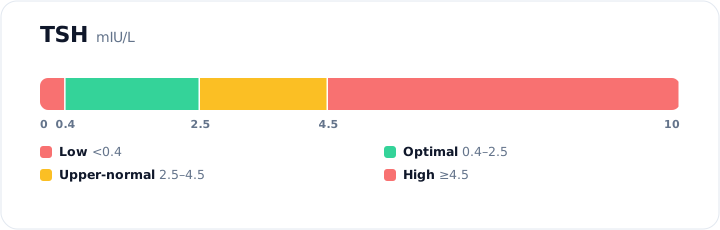
For most adults a normal TSH is 0.4–4.0 mIU/L, the American Thyroid Association range FixFirst uses (FixFirst widens the upper limit to 5.5 from age 65). A TSH of 2.8 sits inside that range, and no major guideline treats it as a problem on its own. Some endocrinologists have argued the upper limit should be 2.5 and others that it should stay where it is (the 2005 Wartofsky and Surks exchange in JCEM). What changes the answer is context: pregnancy, positive TPO antibodies, symptoms, or a TSH that keeps rising between tests. Borderline results covers 2.8 next to other common in-between numbers.
What TSH actually measures
TSH is a pituitary hormone, not a thyroid hormone. That distinction matters when you're trying to interpret the number.
Taking thyroid medication before your blood draw
Whether to take your dose before or after the draw depends on which medication you're on, T4-only and T3-containing drugs behave differently.
Reading the number: reference range vs functional zone
The ATA reference range spans a 10-fold difference in TSH values. A result at 0.5 and a result at 3.8 are both "normal" by most labs, but they reflect very different thyroid states.
| Zone | TSH (mIU/L) |
|---|---|
| Overt hyperthyroidism (flagged) | <0.1 |
| Subclinical hyperthyroidism | 0.1–0.39 |
| Reference range (ATA) | 0.4–4.0 |
| Upper half of the range: normal; look further only with symptoms | 2.5–4.0 |
| Subclinical hypothyroidism | 4.1–10.0 |
| Overt hypothyroidism (flagged) | >10.0 |
Source: ATA Guidelines for Hypothyroidism in Adults, 2014
The ATA reference range was derived from population studies, not from clinical outcomes. It tells you where most healthy adults without known thyroid disease fall, not where most people feel their best. Studies of levothyroxine-treated patients (including work published in the Journal of Clinical Endocrinology & Metabolism) have found that symptom burden is higher at TSH above 2.5 mIU/L than at TSH between 1.0 and 2.5 mIU/L, even when both values sit within the reference range. The ATA guidelines acknowledge this gap in their 2014 document, noting that the optimal TSH target for treated patients is uncertain.
This doesn't mean a TSH of 3.2 needs treatment. It means that if TSH is in the upper quarter of the reference range and you have multiple symptoms of low thyroid function, persistent fatigue, cold sensitivity, hair thinning, constipation, low mood, the next step is to add free T4 and TPO antibodies to the panel. A TSH alone cannot rule out early Hashimoto's or sub-optimal conversion.
TSH in hypothyroidism and hyperthyroidism: what each direction means
The direction of the abnormality points to different causes, different symptoms, and different next steps.
High TSH means the pituitary is sending an amplified signal to the thyroid. The most common cause in adults is Hashimoto's thyroiditis, an autoimmune condition where antibodies gradually damage thyroid tissue. Confirmed with elevated TPO antibodies alongside high TSH and low or low-normal free T4.
Subclinical hypothyroidism is defined as TSH above the reference range with normal free T4 and no or minimal symptoms. It may progress to overt hypothyroidism or stabilise. Monitoring every 6–12 months is standard.
Overt hypothyroidism (TSH above 10 mIU/L, or high TSH with low free T4) warrants treatment with levothyroxine in most cases per ATA 2014 guidelines.
Low TSH means thyroid hormones are high enough that the pituitary has reduced its signal. In overt hyperthyroidism, Graves' disease being the most common spontaneous cause, TSH is typically fully suppressed below 0.05 mU/L, often undetectable on standard assays. The classical Graves' pattern is suppressed TSH alongside elevated free T3 and the presence of TSH receptor antibodies (TRAb).
Subclinical hyperthyroidism sits in the 0.1–0.4 mU/L range with normal free T4 and free T3. A TSH of 0.2 mU/L and a TSH of 0.02 mU/L are not the same clinical situation: the former may stabilise without treatment, the latter warrants investigation regardless of symptoms. In older adults, even subclinical TSH suppression raises the risk of atrial fibrillation.
Other causes include toxic thyroid nodules, multinodular goitre, thyroiditis, and over-replacement on levothyroxine. TRAb testing distinguishes Graves' from non-autoimmune causes and drives the treatment decision.
When TSH alone isn't enough
A standalone TSH answers one question. These tests fill the gaps it leaves.
What to do with your result
The action depends on which zone your TSH falls in and whether symptoms are present.
Your questions, answered
What does a TSH blood test measure?
What is a normal TSH level?
What does high TSH mean?
What does low TSH mean?
Can high or low TSH cause hair loss?
Do I need to fast before a TSH test?
Are you supposed to take thyroid medication before a blood test?
What medications or supplements should you not take before a thyroid test?
What should you not do before a TSH test?
What tests should I request alongside TSH?
What is TSH in hyperthyroidism?
References & Guidelines
- Wartofsky L, Dickey RA — The evidence for a narrower thyrotropin reference range is compelling. J Clin Endocrinol Metab. 2005;90(9):5483-8
- Surks MI, Goswami G, Daniels GH — The thyrotropin reference range should remain unchanged. J Clin Endocrinol Metab. 2005;90(9):5489-96
- American Thyroid Association — Clinical Practice Guidelines
- NICE CKS — Hypothyroidism
See your full thyroid picture
Upload your blood test and FixFirst identifies borderline thyroid values most labs mark green, and ranks which marker to address first.
Analyze My Blood Test →