Your CMP results: which of the 14 markers to fix first

A comprehensive metabolic panel reports 14 numbers across four body systems. Most doctors discuss the flagged ones. Here's which ones actually signal a problem early, and what the reference ranges miss.
Referenced to ADA, AASLD, and KDIGO guidelines Optimal zones, not just reference ranges Priority order for when multiple markers are off
Already have your results?
Upload your CMP to see your personal priority order, which marker needs attention first, and what to do about it.
Upload your report to get your priority order

What a CMP actually measures

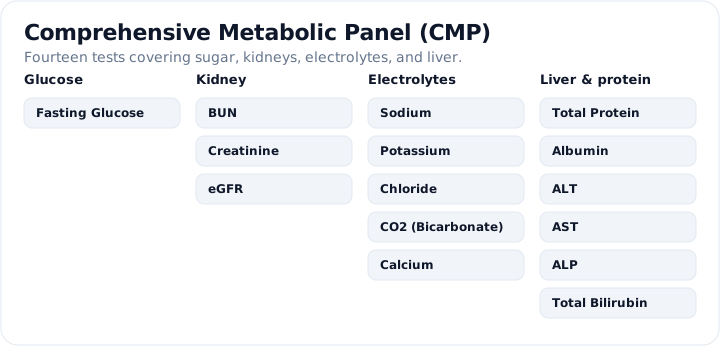
The 14 markers split across four systems. Not all of them are equally concrete, and some of the most meaningful signals sit in zones that labs don't flag.

Metabolic
Glucose + Calcium
Glucose Primary screen for diabetes and insulin resistance. The marker with the largest gap between "reference range" and optimal. High priority
Calcium Controlled by parathyroid and kidneys. Abnormal values in either direction affect cardiac and neuromuscular function. Medium priority
Kidney function
BUN, Creatinine, eGFR
eGFR The most meaningful kidney number on the panel, your filtration rate per minute. High priority
Creatinine Muscle waste product cleared by kidneys. Best read alongside eGFR rather than in isolation. Medium priority
BUN Elevated BUN with normal creatinine often reflects dehydration or high protein intake rather than kidney disease. Lower priority in isolation
Liver function
ALT, AST, ALP, Bilirubin, Albumin, Total Protein
ALT Most sensitive marker for early liver cell damage. Labs use a threshold that misses many early cases. High priority
AST Released from liver and muscle. Read with ALT: the ratio tells you whether this is liver or muscle origin. Medium priority
ALP Elevated with elevated GGT or bilirubin → liver or bile duct. Elevated alone → more likely bone origin. Medium priority
Albumin Reflects liver synthetic capacity. Low albumin means chronic impairment, not acute. it has a 20-day half-life. Medium priority
Bilirubin Pigment from red blood cell breakdown. Useful for differentiating liver from bile duct from haemolytic causes. Medium priority
Total protein Sum of albumin and globulin. Less specific than albumin alone; most useful when both are abnormal together. Lower priority in isolation
Electrolytes
Sodium, Potassium, Chloride, CO₂
Sodium Governs fluid distribution. Abnormal values are driven by hydration and kidney function, rarely by dietary intake. Usually not diet-responsive
Potassium Critical for cardiac electrical activity. Both high and low values carry heart rhythm risk. Clinically urgent if far out of range
Chloride Mirrors sodium to maintain acid-base balance. Rarely a standalone concern. Lower priority
CO₂ / Bicarbonate Acid-base buffer. Abnormal values reflect underlying kidney or metabolic issues. Lower priority

Where reference ranges miss the signal

Labs flag values that clear a population-level threshold. For glucose and liver enzymes, the most concrete zone sits just inside that threshold, where labs give you a green tick but the trend has already started.

Glucose (fasting)
The most important number on the CMP for long-term disease risk, and the one with the largest gap between what labs flag and where the ADA draws the clinical line.
ZoneValue (fasting)
Diabetes (flagged)≥126 mg/dL
Prediabetes (flagged)100–125 mg/dL
Reference range upper bound99 mg/dL
Optimal, metabolic health<90 mg/dL

Source: ADA Standards of Care 2024

The gap that matters: Fasting glucose of 94 mg/dL gets a green tick on your lab report, it's within reference range. The ADA's optimal target for metabolic health is below 90 mg/dL. That 4-point gap, held over years, is where early insulin resistance develops before HbA1c ever shifts. Roughly 98 million U.S. adults are in the prediabetes range (100–125 mg/dL); the majority don't know it.
ALT (liver enzyme)
The most sensitive marker for early liver cell damage on a standard CMP. Most labs use a threshold that was set before non-alcoholic fatty liver disease (NAFLD) became the most common liver condition in the world.
ZoneValue
Lab reference (flagged)≥40 U/L (most labs)
AASLD upper limit of normal34 U/L men, 25 U/L women
Borderline zone (warrants monitoring)20–34 U/L men, 15–25 U/L women
Optimal<20 U/L men, <15 U/L women

Source: AASLD 2023 Clinical Practice Guidelines

Why the standard threshold is too high: Most labs still use 40 U/L as their upper normal for both sexes. The AASLD updated its thresholds to 34 U/L (men) and 25 U/L (women) based on data showing that early NAFLD produces persistent ALT elevations in this lower range. An ALT of 37 U/L in a woman gets a green tick on most lab reports. It shouldn't.
eGFR (kidney filtration rate)
The most clinically meaningful kidney number on the panel. A single low reading doesn't diagnose CKD. KDIGO requires confirmation over 90 days, but the stage tells you how much urgency to apply.
KDIGO StageeGFR (mL/min/1.73m²)
G5 — Kidney failure<15
G4 — Severely reduced15–29
G3b — Moderate–severe30–44
G3a — Mild–moderate45–59
G2 — Mildly reduced60–89
G1 — Normal≥90

Source: KDIGO 2022 CKD Guidelines

Potassium
Potassium is one of the few electrolytes where abnormal values carry direct cardiac risk. Both high and low extremes can cause arrhythmia, the concern is not just "how far out of range" but "how fast it got there."
ZoneValue (mEq/L)
Severe hyperkalaemia (flagged)≥6.0
Mild–moderate hyperkalaemia5.1–5.9
Normal range3.5–5.0
Mild hypokalaemia3.0–3.4
Moderate hypokalaemia (flagged)<3.0

Priority order: which marker to address first

If multiple markers are off, address them in this order, based on clinical urgency, how responsive they are to lifestyle changes, and what actually moves each one.

1
Glucose first, it's the most reversible at early stages

Prediabetes (100–125 mg/dL) is largely reversible with lifestyle changes. Once it becomes Type 2 diabetes (≥126 mg/dL on two readings), reversal requires more intensive intervention and is not guaranteed.

What moves fasting glucose fastest: cut refined carbohydrates and added sugar, the single most effective dietary intervention. Move after meals: a 10–15 minute walk after eating lowers post-meal glucose by 20–30% in most people. Resistance training increases insulin sensitivity faster than cardio does for fasting glucose. Lose 5–10% of body weight if overweight: this alone produces the largest and most sustained glucose reduction of any lifestyle intervention per the ADA.

Fasting glucose of 90–99 mg/dL is within reference range, still warrants a dietary review if it's crept up from a previous lower reading. The trend matters as much as the absolute value.

Retest at 8–12 weeks
2
Liver enzymes second. ALT and AST respond to lifestyle

Elevated ALT and AST in the 1–3x upper-normal range are most often caused by non-alcoholic fatty liver disease, alcohol, or medications. All three respond to intervention. ALT typically normalises within 8–12 weeks of sustained dietary changes.

What works: reduce alcohol (ALT begins normalising within 2–4 weeks of abstinence in alcohol-related cases). Cut refined carbohydrates and fructose, the dietary drivers of hepatic fat accumulation. Lose 7–10% of body weight if overweight: this level of weight loss produces histological improvement in NAFLD, not just enzyme normalisation. Aerobic exercise at 150 min/week reduces liver fat independently of weight loss.

ALT values above 3x the upper limit of normal warrant further investigation (ultrasound, hepatitis B/C testing) before assuming lifestyle cause.

Retest at 8–12 weeks
3
Kidney markers third, management over reversal

Unlike glucose and liver enzymes, impaired kidney function (eGFR below 60) doesn't typically reverse with lifestyle changes. The goal is to slow progression. Confirmed KDIGO G3a or below (eGFR below 59) should involve a clinician, management includes blood pressure control (target below 130/80 mm Hg per KDIGO), protein intake optimisation, and monitoring for worsening.

A single low eGFR reading is not diagnostic. Acute illness, dehydration, heavy exercise, and certain medications can all temporarily suppress eGFR. Confirm with a repeat test 90 days later before drawing conclusions.

BUN elevated with normal creatinine and eGFR is often dehydration or high protein intake, address those before treating it as kidney disease.

4
Electrolytes last, most are not diet-responsive

Sodium, chloride, and bicarbonate abnormalities are rarely driven by diet. They reflect fluid status, kidney function, or hormonal dysregulation. If your glucose, liver, and kidney markers are fine and only sodium or CO₂ is slightly out of range, the most likely explanations are hydration status at the time of the draw or a lab artifact from a difficult blood draw.

Potassium is the exception. Mildly low potassium (3.0–3.5 mEq/L) does respond to dietary intervention, increase potassium-rich foods (bananas, spinach, sweet potato, avocado) and reduce sodium intake. If you're on a diuretic, discuss potassium supplementation with your doctor. Potassium above 5.5 mEq/L warrants investigation regardless of symptoms. it can affect cardiac rhythm without warning.

Once you know which marker needs attention

General priority order is a starting point. Your specific combination of results, and your history, changes what matters most.

Upload to FixFirst
See your personal priority order based on your actual numbers
FixFirst reads your full CMP, including borderline values labs don't flag, and ranks which marker to address first based on your specific results.
Upload My Report →
Liver markers elevated?
What ALT, AST, ALP, and GGT actually tell you
A deeper look at liver function markers, including GGT, which isn't on a standard CMP but is the most sensitive early-warning signal for liver stress.
Read the cholesterol guide

Your questions, answered

What does a comprehensive metabolic panel test for?
A CMP measures 14 markers across four systems: glucose and calcium; kidney function (BUN, creatinine, eGFR); liver function (ALT, AST, ALP, bilirubin, albumin, total protein); and electrolytes (sodium, potassium, chloride, bicarbonate). It's used as a broad metabolic screen at annual checkups and is one of the most commonly ordered blood panels in the U.S.
What is the difference between a CMP and a BMP?
A basic metabolic panel (BMP) covers 8 markers: glucose, calcium, the four electrolytes (sodium, potassium, chloride, CO2), and the two kidney markers (BUN and creatinine). A CMP adds the six liver markers (ALT, AST, ALP, bilirubin, albumin, total protein) for a total of 14 markers. The CMP gives a more complete picture of liver health, which is why it's the more common annual screening panel for most adults.
What is a normal CMP result?
Lab reference ranges define normal as: fasting glucose 70–99 mg/dL, ALT below 40 U/L, AST below 40 U/L, creatinine 0.6–1.2 mg/dL, eGFR above 60, sodium 136–145 mEq/L, potassium 3.5–5.0 mEq/L, and albumin 3.5–5.0 g/dL. These are population-level thresholds, not optimal targets. Fasting glucose of 94 mg/dL is within reference range, the ADA's optimal target for metabolic health is below 90 mg/dL. The gap between "normal" and "optimal" is where early metabolic disease develops.
Which CMP marker matters most?
Glucose is the highest-priority CMP marker for long-term metabolic risk, prediabetes (100–125 mg/dL) affects roughly 98 million U.S. adults and is largely reversible if caught early. For liver health, ALT is the most sensitive marker for early liver cell damage. For kidney health, eGFR is more meaningful than creatinine alone. If multiple markers are off, address glucose and liver enzymes before electrolyte abnormalities, the latter are rarely diet-responsive.
Do you need to fast for a CMP?
Yes: 8 to 12 hours of fasting is recommended. Glucose is the most fasting-sensitive marker: eating beforehand can push it by 20–40 mg/dL and produce a falsely elevated reading. Albumin, electrolytes, and liver enzymes are minimally affected by recent food. If your draw was non-fasting and glucose is borderline, request a fasting repeat before drawing clinical conclusions.
What does high ALT on a CMP mean?
Elevated ALT means liver cells are leaking their contents into the bloodstream, a sign of inflammation or damage. The AASLD upper limit of normal is 34 U/L for men and 25 U/L for women (many labs still use 40 U/L for both, which misses early cases). The most common causes are non-alcoholic fatty liver disease, alcohol, medications, and viral hepatitis. Values 1–3x the upper limit often respond to lifestyle change. Values above 3x upper limit warrant further investigation before assuming lifestyle cause.
What does low eGFR mean on a CMP?
eGFR below 60 mL/min/1.73m² falls into KDIGO's CKD stages (G3a or below) and warrants follow-up. A single low reading is not diagnostic, confirm with a repeat test 90 days later, since acute illness, dehydration, and medications can temporarily suppress eGFR. KDIGO G3a (45–59) with a confirmed trend means careful blood pressure management and monitoring. G4 (15–29) or G5 (below 15) requires nephrology referral.
Medical disclaimer: FixFirst is an educational tool, not a medical device. Content is reviewed by a qualified medical advisor. Reference ranges and thresholds cited are based on published clinical guidelines including ADA Standards of Care 2024, AASLD 2023 Clinical Practice Guidelines, and KDIGO 2022 CKD Guidelines. Always consult a licensed healthcare provider before making changes to your health plan.

See your personal priority order

Upload your CMP, or any blood test, and FixFirst ranks your markers by what actually needs attention. Free, no account needed.

Upload My Report →