Your lipid panel results: which number to fix first
A standard lipid panel gives you four numbers. Most labs flag one of them, rarely the most concrete one. Here's what the reference ranges don't tell you, and where to start.
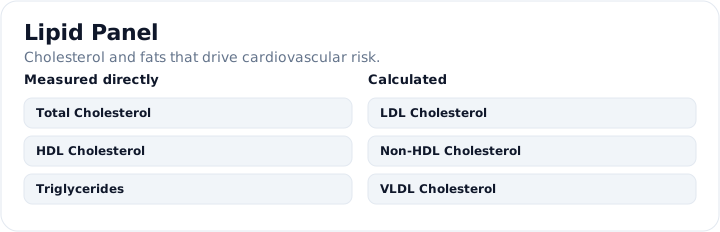
What a lipid panel actually measures
A standard panel reports four numbers. Two of them are more useful than the other two, and the most predictive cardiovascular marker isn't on the panel at all.
How to read the numbers: reference range vs optimal
The reference ranges on your lab report are not optimal targets. They're the cutoffs where population-level risk becomes statistically significant. "Normal" means you're not in the danger zone, it doesn't mean you're running well.
| Zone | Value |
|---|---|
| Lab reference (flagged) | ≥160 mg/dL |
| Borderline high | 130–159 mg/dL |
| Near-optimal | 100–129 mg/dL |
| Optimal, general population | <100 mg/dL |
| Optimal, high cardiovascular risk | <70 mg/dL |
| Optimal, very high risk | <55 mg/dL |
Source: ACC/AHA 2019 Cardiovascular Risk Guidelines
| Zone | Value |
|---|---|
| Lab reference, low (flagged) | <40 mg/dL men, <50 mg/dL women |
| Acceptable | 40–59 mg/dL |
| Optimal | ≥60 mg/dL |
| Zone | Value |
|---|---|
| Lab reference (flagged) | ≥150 mg/dL |
| Borderline high | 150–199 mg/dL |
| Optimal, general | <100 mg/dL |
| Optimal, metabolic health | <80 mg/dL |
Non-HDL cholesterol: Optimal non-HDL is 30 mg/dL above your LDL target. For the general population: <130 mg/dL. For high cardiovascular risk: <100 mg/dL. Use this over total cholesterol as your summary number.
ApoB (apolipoprotein B): If your LDL is borderline (100–129 mg/dL), ask your doctor to add ApoB to your next draw. The 2026 ACC/AHA dyslipidemia guideline sets risk-dependent ApoB goals: under 90 mg/dL for primary prevention at lower risk when triglycerides are 150–499 mg/dL, under 70 mg/dL at higher risk (same triglyceride range for primary prevention), and under 55 mg/dL for clinical ASCVD at very high risk. It also lists ApoB of 120 mg/dL or higher as a risk-enhancing factor. Which goal applies is set with a clinician. One add-on to a standard panel, and it gives a clearer cardiovascular risk picture than LDL-C alone.
Priority order: what to address first
If more than one marker is off, address them in this order, based on how fast each responds and what actually moves it.
Triglycerides respond to dietary changes within 4–6 weeks, faster than any other lipid marker. The main drivers are refined carbohydrates (white bread, pasta, rice, sugar), alcohol, and excess total calorie intake.
What moves them fastest: cut added sugar and refined carbs first, this single change does more than any other dietary intervention. Reduce alcohol; even moderate intake raises triglycerides meaningfully. Add 2–4g of EPA/DHA daily: at that dose, omega-3s lower triglycerides by 15–30% in elevated ranges. Time-restricted eating (16:8 or similar) reduces fasting triglycerides in most people within 4–8 weeks.
Triglycerides above 500 mg/dL warrant a medication conversation. Below that, dietary intervention is first-line.
LDL moves more slowly than triglycerides. Expect 8–12 weeks for meaningful change. The evidence-backed interventions:
10g of soluble fibre daily (oats, beans, lentils, psyllium) reduces LDL by 3–5% on its own, the most consistent single dietary lever. Replacing saturated fat with unsaturated fat (olive oil, nuts, avocado) is the primary dietary protocol per ACC/AHA guidelines. Plant sterols at 2g daily reduce LDL by 5–10%. Aerobic exercise at 150 min/week has modest direct LDL effects but improves LDL particle size distribution, smaller, denser particles carry more risk.
If LDL stays above 160 mg/dL after 3 months of consistent changes, or is above 190 mg/dL at baseline, ACC/AHA guidelines typically recommend statin therapy.
HDL is the hardest marker on this panel to raise. Most dietary changes have modest effects. The clearest lever is aerobic exercise: 30 minutes of moderate-intensity cardio (running, cycling, swimming) 5 days per week raises HDL by roughly 3–5 mg/dL. That matters more if you start at 38 mg/dL than if you start at 55 mg/dL.
Cutting dietary fat can actually lower HDL. Most supplements don't move it meaningfully. Niacin raises HDL significantly but carries cardiovascular risk tradeoffs that make it a non-first-line option outside medical supervision.
Once you know which marker to target
General priority order is a starting point. Your specific combination of results changes what matters most.
Your questions, answered
What does a lipid panel blood test show?
What is a normal lipid panel result?
What is the difference between a lipid panel and a lipid profile?
Which result on a lipid panel matters most?
Do I need to fast before a lipid panel?
What should I do if my lipid panel is abnormal?
Is ApoB included in a standard lipid panel?
References & Guidelines
See your personal priority order
Upload your lipid panel, or any blood test, and FixFirst ranks your markers by what actually needs attention. Free, no account needed.
Analyze My Blood Test →