Fasting Insulin: The Blood Test That Catches Insulin Resistance Years Early
Fasting insulin isn't on a standard panel. Most GPs won't order it unprompted. But it's the most sensitive early signal for insulin resistance, when HbA1c and glucose still look fine.
Why fasting insulin isn't on your standard panel
The gap in routine screening isn't an oversight. It's a combination of cost, standardisation, and clinical inertia, with real consequences for early detection.
Standard blood panels were designed around conditions that are already diagnosable, not those that are developing. Fasting glucose and HbA1c are the primary tools for diagnosing pre-diabetes and type 2 diabetes, but they measure the consequence of insulin resistance (elevated blood glucose), not the cause (impaired cellular response to insulin). By the time glucose rises, the pancreas has typically been overcompensating with excess insulin for years.
Fasting insulin is absent from routine panels for three practical reasons: it adds cost, the insulin assay is less standardised across laboratories than glucose, and most clinical guidelines still centre on glucose and HbA1c as the primary screening markers. The result is a systematic blind spot: the window where intervention is easiest and most effective is the one that routine testing misses.
If you have any of the risk factors covered below (family history, PCOS, central weight gain, high triglycerides with low HDL), requesting fasting insulin alongside your routine bloods is a low-cost, high-information addition.
What fasting insulin actually measures
Insulin is not just a blood sugar hormone. It's the central regulator of energy storage, and when cells stop responding to it properly, the consequences run far wider than glucose levels.
Insulin is produced by the beta cells of the pancreas and released into the blood in response to rising glucose, primarily after eating. Its job is to signal cells, particularly in muscle, liver, and fat tissue, to absorb glucose from the blood. After an overnight fast, when no food has been consumed for 8–12 hours, blood glucose and insulin should both be at their lowest baseline. The insulin level at this point is your fasting insulin.
In a person with healthy insulin sensitivity, fasting insulin is low because cells respond readily to small amounts of insulin. In a person developing insulin resistance, cells stop responding as efficiently. The pancreas detects that blood glucose isn't being absorbed quickly enough and compensates by producing more insulin. For a time, this compensation works: blood glucose stays normal, glucose readings look fine. But fasting insulin is already elevated, the pancreas is working harder than it should just to maintain a normal result on your standard glucose test.
Elevated fasting insulin with normal fasting glucose is the hallmark of early, compensated insulin resistance. It's the phase where lifestyle changes have the most impact. Once fasting glucose rises, and especially once HbA1c rises, the compensation is starting to fail and the metabolic situation is meaningfully more advanced.
Insulin resistance also drives a cluster of downstream effects beyond glucose: the liver produces more VLDL (raising triglycerides), HDL falls, blood pressure tends to rise, and inflammatory markers increase. High triglycerides alongside low HDL (a common pattern on a standard lipid panel) is itself an indirect signal of insulin resistance, even when glucose looks normal. Fasting insulin is one piece of a wider metabolic optimization picture that also includes HbA1c, the lipid panel, and hs-CRP.
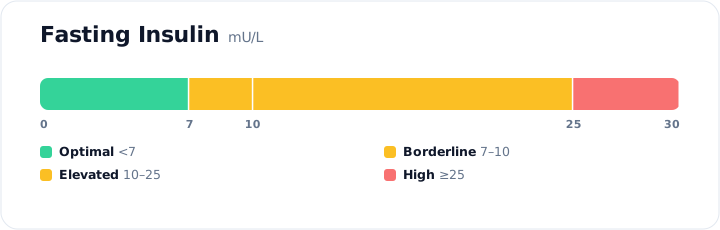
Reference range vs optimal zone
The number on your lab report and the number that matters for metabolic health are not the same thing. Here's how to read your result.
| Fasting insulin level | Lab classification | Clinical picture | Status |
|---|---|---|---|
| Below 7 mU/L (µIU/mL) | Within range | Considered optimal by most clinicians working in metabolic health. Reflects strong insulin sensitivity. Calculate HOMA-IR to confirm alongside fasting glucose. | Optimal |
| 7–10 mU/L | Within range | Still within a functional range but at the higher end of what many metabolic health practitioners consider ideal. Worth monitoring, particularly if triglycerides or HDL also suggest a metabolic pattern. | Acceptable |
| 10–25 mU/L | Within lab reference range | Reported as "normal" by most labs. A value of 15–20 mU/L with normal fasting glucose may already reflect compensatory hyperinsulinaemia, the pancreas working harder than optimal to maintain normal glucose. Calculate HOMA-IR. Consider dietary review. | Monitor |
| Above 25 mU/L | Above lab reference range (flagged high) | Clearly elevated fasting insulin. If fasting glucose is still normal, this is early compensated insulin resistance. If glucose is also rising, compensation is starting to fail. Warrants investigation and intervention. | Address |
The most important thing to understand about fasting insulin reference ranges: they were established from population distributions, not from what is metabolically optimal. A value of 15 mU/L may be common in the reference population without being healthy. This is the same issue that affects many lab reference ranges, the population used to set the range includes people who are metabolically compromised.
Different labs also report insulin in slightly different units and use different assay methods, which makes the absolute number harder to compare directly across tests. This is one reason the test has been slower to standardise than glucose. HOMA-IR, the calculation that combines fasting insulin with fasting glucose, is often more informative than fasting insulin in isolation, it's the number most researchers use as the benchmark for insulin resistance.
HOMA-IR: the calculation that gives context
Fasting insulin alone is useful. Combined with fasting glucose in the HOMA-IR formula, it becomes the standard research measure for insulin resistance.
How to calculate HOMA-IR
HOMA-IR was developed by Matthews et al. and published in Diabetologia (1985), and has since become the standard non-invasive measure of insulin resistance used in research. It is not a clinical diagnostic tool, doctors diagnose pre-diabetes and diabetes using glucose and HbA1c. But for tracking insulin sensitivity before those markers rise, it's the most useful calculation available.
To calculate HOMA-IR, you need both fasting insulin and fasting glucose from the same blood draw, taken after the same overnight fast. This means requesting both tests at the same time. If you have a routine blood test coming up that includes fasting glucose, adding fasting insulin to the same draw is the most efficient way to get the data you need. Once you have both numbers, our HOMA-IR calculator does the arithmetic in either unit system.
Note that different studies use slightly different cut-offs for HOMA-IR, and the thresholds above are the bands FixFirst's analyzer applies, not a single universal standard. Some publications put the insulin resistance cut-off as low as 2.0. The direction matters more than hitting a precise number: HOMA-IR trending up over time is more informative than any single snapshot.
Who should request this test
Fasting insulin is most useful as a proactive marker for people with metabolic risk factors or unexplained symptoms, before standard markers have moved.
How to request fasting insulin from your GP
GPs don't routinely order this test, but there's no clinical reason they can't. A clear, specific request is usually sufficient.
The most direct approach is to name the test and the reason clearly. If you have a risk factor listed above (family history, PCOS, the lipid pattern of high triglycerides with low HDL), you have a concrete clinical justification. The GP doesn't need to agree that insulin resistance is your primary concern; they just need a reasonable clinical basis for the order.
Frequently asked questions
What is a fasting insulin blood test?
What is a normal fasting insulin level?
What does high fasting insulin mean?
What is HOMA-IR and how do I calculate it?
Why isn't fasting insulin on a standard blood test?
Can fasting insulin be low and still indicate a problem?
References & Guidelines
Already have blood results? See what they actually mean.
Upload your report and get a prioritised read on which markers to address first, including insulin resistance patterns visible in your lipid and glucose data. 45 seconds, free, no account.
Analyze My Blood Test →