Blood Tests for Weight Loss: What to Check First

A handful of blood markers can flag a real obstacle, point you toward the diet that fits your body, or give you a baseline to measure against. Most "weight loss panels" oversell the rest. Here is the honest version, with the evidence.
Medically reviewed by Dr. Prahlad Rai Gupta, MBBS, MD (Pulmonary Medicine)

4 marker groups, by role Includes GLP-1 baseline labs Grounded in ADA, ATA, and RCT evidence
Already have results?
If your report shows a raised blood sugar marker, that is the one most worth acting on before a weight loss attempt. See what it means and how to bring it down.
What a high HbA1c means and how to lower it

What blood tests can and can't do for weight loss

Lab panels sold for weight loss tend to promise hidden answers. The evidence is narrower, and more useful once you see what each marker is actually for.

Start with the honest premise. For most people who struggle to lose weight, bloods come back broadly normal, and the work sits in intake, movement, sleep, protein, and consistency. A blood test will not reveal a secret reason the scale won't move. What it can do is rule out the few conditions that genuinely slow progress, tell you which dietary approach suits your physiology, and set a baseline so you can see your metabolism improving even on a week the scale is stuck.

That reframing matters because it changes which results you act on. A raised HbA1c or a top-of-range fasting glucose is worth addressing, both for health and because it shapes your food choices. A mildly raised TSH, by contrast, gets over-blamed: subclinical hypothyroidism shows no independent link with weight gain in prospective data, and levothyroxine does not produce meaningful weight loss in trials (American Thyroid Association).

Low vitamin D is more nuanced. Supplementing it does not burn fat in randomized trials, and the low levels seen with higher body fat are partly a consequence of carrying more fat rather than a cause of it. So it is no metabolic lever. Genuine deficiency, though, causes fatigue and proximal muscle weakness, and correcting a low level reduces both (Nowak et al., 2016). Better energy and stronger legs make it easier to stay active and stick to the plan. The effect is real but indirect, through activity and adherence, the same path as low iron or B12.

So the four groups below are sorted by what each one does for you, not by organ system. Some are obstacles to remove. Some guide the plan. Some only track progress. Knowing the difference keeps you from chasing a number that was never going to change your weight.

Role 1 — Rule out

Obstacles worth excluding

Overt hypothyroidism and undiagnosed diabetes are real, treatable, and uncommon. Bloods catch them. Finding one changes your plan; a normal result clears the path.

Role 2 — Guide the plan

Diet-selection signals

Blood sugar and insulin markers don't predict how much you'll lose, but higher insulin resistance tends to respond better to lower-carbohydrate or lower-glycemic eating in trials.

Role 3 — Support adherence

Energy and consistency

Low iron, vitamin D, or B12 sap energy and training tolerance. Correcting them helps how you feel and how well you stick to the plan, rather than burning fat directly.

Role 4 — Track progress

Metabolic baselines

Triglycerides, ALT, and HbA1c improve as you lose fat. Recorded before you start, they show your metabolism getting healthier even when the scale is slow.

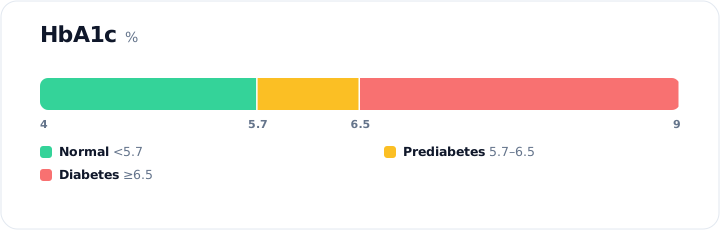
HbA1c reference range chart: normal below 5.7 percent, prediabetes 5.7 to 6.4 percent, diabetes 6.5 percent and above, on ADA thresholds.
HbA1c zones on ADA thresholds — normal below 5.7%, prediabetes 5.7–6.4%, diabetes 6.5% or higher. Of every marker on a weight loss panel, this is the one most worth acting on before you start: it flags blood sugar dysregulation and helps steer your dietary approach.

The 4 marker groups, and what each does

Each group lists the core tests a standard panel usually covers and the ones worth requesting. The note explains what the marker means for weight loss, not just what it measures.

Group 1 of 4 · guides the plan
Blood Sugar & Insulin
The most useful group. It catches early insulin resistance and helps decide whether a lower-carbohydrate approach is likely to suit you.
Core Usually on a metabolic panel Ask Request specifically
Core
Fasting Glucose
ADA prediabetes: 100–125 mg/dL. A reading of 90–99 is normal but high in the range, and often the first sign of insulin resistance worth steering your diet around.
Ask
HbA1c
Your 3-month blood sugar average. ADA prediabetes: 5.7–6.4%. A raised value is both a health flag and a reason to favour lower-glycemic eating. See how to lower a high HbA1c.
Ask
Fasting Insulin
The earliest marker of insulin resistance, often raised years before glucose moves. People with higher insulin resistance tend to lose more on lower-carbohydrate diets. The fasting insulin test is rarely run by default.
Group 2 of 4 · rule out
Thyroid Function
Worth checking once to exclude overt hypothyroidism. Worth understanding so you don't blame a borderline result for stubborn weight.
Core Often on a standard panel Ask Request if TSH is off
Core
TSH (Thyroid-Stimulating Hormone)
ATA range: 0.4–4.0 mIU/L. A clearly high TSH points to hypothyroidism worth treating. A mildly raised value is not a proven cause of weight gain. The TSH test guide covers the borderline zone.
Ask
Free T4 (FT4)
The thyroid's main output. A low FT4 alongside a high TSH confirms overt hypothyroidism. Useful to confirm a finding, not to screen on its own. See how to read a thyroid panel.
Ask
What the evidence says
Treating subclinical hypothyroidism does not cause meaningful weight loss in trials, and the weight lost when overt disease is first treated is largely water. Rule it out; don't expect it to be the answer. More on a high TSH result.
Group 3 of 4 · supports adherence
Iron & Nutrients
These don't burn fat. They affect energy and training tolerance, which is what keeps you consistent week to week.
Core Sometimes included Ask Usually a specific order
Ask
Ferritin
Iron stores. Low ferritin reduces energy and exercise tolerance; correcting it eases fatigue in trials, though performance gains are mixed. NICE depletion threshold: <30 ng/mL. See low ferritin.
Ask
Vitamin D (25-OH)
NIH: deficiency <20 ng/mL, insufficiency 20–29. Real deficiency causes fatigue and proximal muscle weakness that undercut activity; correcting it helps energy more than it touches the scale directly. Topping up a normal level does nothing for weight. See low vitamin D.
Ask
Vitamin B12
Low B12 causes fatigue that undercuts activity. Higher risk on metformin, which many people starting weight loss also take. NICE borderline zone: 140–220 pg/mL. See low vitamin B12.
Group 4 of 4 · tracks progress
Metabolic Baselines
Recorded before you start, these show your metabolism improving as you lose fat, often before the scale agrees.
Core Usually on a CMP or lipid panel Ask Confirm it's included
Core
Triglycerides
Often the fastest marker to improve on a fat-loss plan. Normal is <150 mg/dL. A raised result also signals insulin resistance. See high triglycerides and the lipid panel.
Core
ALT (liver enzyme)
A raised ALT can flag fatty liver, common with central weight gain and one of the clearest things to improve through fat loss. Part of the liver function tests.
Core
HbA1c (again, as a baseline)
It guides the plan in Group 1 and tracks progress here. A falling HbA1c over a few months is solid proof your metabolic health is moving, scale or not.

Starting a GLP-1? The baseline labs that matter

If you're considering semaglutide (Ozempic, Wegovy) or tirzepatide (Mounjaro, Zepbound), your prescriber will usually take a baseline first. These are the markers and why they're checked.

Typical pre-treatment baseline
HbA1c
The central baseline. It records your glycemic starting point and becomes the benchmark your prescriber uses to judge whether the medication is working.
Kidney function
eGFR and creatinine. These drugs clear through the kidneys, and the nausea or vomiting some people get early on can cause dehydration that strains them. A baseline catches any later decline.
Lipid panel + ALT
A metabolic snapshot before you start. Both tend to improve with weight loss, so the starting values let you and your prescriber see the gain.
Thyroid (TSH)
Often noted given the medication labeling. Discuss your thyroid history with your prescriber rather than reading anything into a routine TSH yourself.
These are clinical baselines a prescriber orders and interprets, not a self-treatment checklist. A GLP-1 should be started and monitored under medical supervision. The value of the baseline is the comparison it gives you three and six months in.

How to ask for these tests

Being specific about the test and the reason changes what gets ordered. Here's a request that covers the useful markers without over-testing.

What to say at your appointment
"I'm about to make a serious effort to lose weight and I'd like a baseline first. Could we run HbA1c and fasting glucose, a lipid panel with triglycerides, ALT, TSH, and ferritin and vitamin D? I want to rule out anything that would slow me down and have numbers to measure progress against."
If fasting insulin interests you, add it by name; it's informative when your fasting glucose sits at the high end of normal. If your doctor declines the extras, direct-to-consumer labs (Ulta Lab Tests or Walk-In Lab in the US; Medichecks or Thriva in the UK) run metabolic, thyroid, and nutrient panels without a referral. A full baseline like this is one morning blood draw.

Once you have your results

Getting the right tests run is step one. Reading them in context, not just pass or fail, is step two.

Upload to FixFirst
See which markers matter most for you, in 45 seconds
Upload your PDF and FixFirst reads 40+ markers, including borderline blood sugar and metabolic values, and ranks your top 3 priorities for your sex, age, and goals.
Upload My Report →
Blood sugar flagged?
What a high HbA1c means and how to lower it
Of the markers here, a raised HbA1c is the one most worth acting on before a weight loss attempt. This covers what it means, how fast it moves, and the changes that lower it.
Read the high HbA1c guide

Your questions, answered

What blood tests should I get before trying to lose weight?
A useful baseline covers four areas: blood sugar and insulin (fasting glucose, HbA1c, and fasting insulin where available), thyroid function (TSH, with free T4 if TSH is abnormal), iron and key nutrients (ferritin, vitamin D, and B12), and metabolic baselines (a lipid panel including triglycerides, plus ALT to flag fatty liver). Most come on a standard CBC and metabolic panel; ferritin, fasting insulin, and vitamin D usually need requesting. The point is not that fixing a number melts fat. It is to rule out the few conditions that genuinely slow progress, choose a dietary approach that fits your physiology, and set a baseline you can measure against later.
Can a blood test tell me why I can't lose weight?
Sometimes, but less often than weight-loss lab panels imply. A small share of stubborn cases trace to a treatable condition such as overt hypothyroidism or undiagnosed diabetes, and bloods will catch those. For most people the labs come back broadly normal, and the explanation is energy balance, sleep, medications, or adherence rather than a hidden hormone. Where bloods do help the majority is in matching the plan to the person: higher insulin resistance appears to respond better to lower-carbohydrate or lower-glycemic diets in some trials, though baseline insulin is not a reliable predictor of how much weight you'll lose overall (POUNDS LOST, NEJM 2009; POINTS, Nature Communications 2023).
Does an underactive thyroid stop you losing weight?
Overt hypothyroidism slows metabolism and is worth ruling out, but its effect on weight is smaller than commonly assumed, and treatment is not a weight-loss tool. In subclinical hypothyroidism (mildly raised TSH, normal free T4), prospective data found no independent link with weight gain, and randomized trials show levothyroxine does not produce meaningful weight loss (American Thyroid Association; Cardiovascular Health Study, JCEM 2014). The weight some people lose when overt hypothyroidism is first treated is largely water, not fat. Check TSH to find the uncommon real case; don't expect a normal-to-borderline result to be the reason the scale won't move.
Will low vitamin D stop me from losing weight?
Not directly, but there's an indirect path worth knowing. Supplementing vitamin D has little or no effect on body weight or fat mass in randomized trials (Pathak et al., 2014; Mallard et al., 2016), and Mendelian randomization shows the low levels seen with higher body fat are largely a consequence of carrying more fat, not a cause of weight gain. So it is no metabolic lever. What it can do: genuine deficiency causes fatigue and proximal muscle weakness, and correcting a low level reduces fatigue and improves muscle strength in deficient people (Nowak et al., 2016). Better energy and stronger legs make it easier to stay active and consistent, which supports weight loss the same indirect way low iron and B12 do. One caveat: this applies when you're actually deficient. Topping up an already-normal level won't help.
What blood tests do I need before starting Ozempic, Wegovy, or Mounjaro?
Prescribers typically establish a baseline before a GLP-1 (semaglutide) or GLP-1/GIP (tirzepatide) agent. HbA1c is the central one: it records your starting glycemic status and becomes the benchmark for tracking response. Kidney function (eGFR and creatinine) is checked because these drugs clear through the kidneys and because dehydration from nausea or vomiting can strain them. A lipid panel and ALT give a metabolic baseline, and thyroid status is often noted given the labeling. These are clinical baselines your prescriber orders, not a self-treatment checklist. Always start a GLP-1 under medical supervision.
Does fasting insulin matter for weight loss?
Fasting insulin is the earliest marker of insulin resistance and can be raised years before fasting glucose or HbA1c move. For weight loss its value is mainly in choosing an approach rather than predicting success: people with greater insulin resistance tended to lose more on lower-glycemic or lower-carbohydrate diets in several trials, while those who are insulin-sensitive did similarly across diet types. It is rarely on a standard panel and is most informative when fasting glucose sits at the high end of normal (90–99 mg/dL) alongside central weight gain or afternoon energy crashes.
Can low iron make weight loss harder?
Indirectly. Low iron stores (low ferritin) sap energy and exercise tolerance, which makes it harder to stay active and consistent. A systematic review of randomized trials found that iron supplementation in non-anemic iron-deficient adults reduces the feeling of fatigue, though objective gains in physical performance were inconsistent (Houston et al., CMAJ 2018). So correcting low ferritin can help how you feel and how well you train, without being a direct fat-loss mechanism. Ferritin is not on a standard CBC and needs requesting.
My weight loss bloods came back normal. Now what?
Normal bloods are the common and reassuring result: they mean no medical condition is blocking you, so the levers are energy intake, movement, sleep, protein, and consistency. Two caveats. First, the most useful tests (fasting insulin, ferritin, vitamin D) may not have been ordered, so check what was actually run. Second, standard ranges flag disease, not borderline values, so it's worth seeing where each result sits within its range rather than only whether it passed. A high-normal HbA1c or a top-of-range fasting glucose can still steer your dietary choices even when nothing is flagged.
Medical disclaimer: FixFirst is an educational tool, not a medical device. Content is reviewed by Dr. Prahlad Rai Gupta, MBBS, MD. Reference ranges and thresholds are based on published clinical guidelines from the ADA, ATA, NICE, NIH, Endocrine Society, and ACC/AHA. Weight loss medications such as GLP-1 agents must be prescribed and monitored by a licensed clinician. Always consult a healthcare provider before making changes to your health plan.

Have your results? See which markers matter most before you start.

Free. No account. Works with any lab report in 45 seconds.

Upload My Report →