← All blood test guides

Segmented Neutrophils: What Your Count Actually Means

Your differential reports segmented neutrophils as a percentage. Clinicians act on the absolute number instead, and for millions of people a count below the lab range is their normal. Here is how to read both.
Medically reviewed · Guideline-anchored
Reviewed by Dr. Prahlad Rai Gupta, MBBS, MD · Thresholds anchored to ASH & NICE guidance · Evidence & Methodology
Based on ASH & NICE guidance 121 markers analysed Free, no account needed
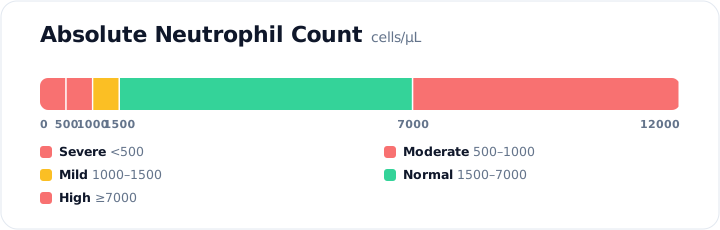
Absolute neutrophil count range chart: severe below 500, moderate 500 to 999, mild 1,000 to 1,499, normal 1,500 to 7,000, and high above 7,000 cells per microlitre.
Absolute neutrophil count zones — severe neutropenia below 500, moderate 500–999, mild 1,000–1,499, normal 1,500–7,000 cells/µL (CTCAE-aligned; some labs report normal up to 8,000). Duffy-null individuals sit roughly 2,000 cells/µL lower with no increased infection risk (ASH; Blood Advances 2023).
What it is

What segmented neutrophils measure

Segmented neutrophils (often shortened to "segs") are mature neutrophils, named for the segmented shape their nucleus takes as the cell matures. They are the most abundant white blood cell and the first responders to bacterial and fungal infection. Your differential reports them as a percentage of total white cells.

Why it matters

Why the percentage alone tells you little

A neutrophil percentage of 40% means something different when your total white count is 3,000 than when it is 11,000. The absolute neutrophil count (ANC) converts the percentage into a number of cells, and ANC is what infection risk and treatment decisions are based on.

Reading the differential: percentage, absolute count, and left shift

Three numbers on the same report answer different questions. The percentage describes the mix, the absolute count describes the supply, and the band count describes how hard the bone marrow is working.

ANC
The number clinicians act on
Absolute neutrophil count = total white cell count × (segmented % + band %) ÷ 100. Most labs calculate and report it, but not all differentials show it.
1,500
Cells/µL — the usual neutropenia threshold
ANC below roughly 1,500/µL is conventionally labelled neutropenia. This threshold was derived from populations that under-represent Duffy-null individuals.
~2,000
Cells/µL lower in Duffy-null individuals
A group-level average, not a fixed offset that applies to any one person. Duffy-null (ACKR1) individuals circulate fewer neutrophils with normal marrow and a normal response to infection. Figure from Merz et al., Blood Advances 2023;7(3):317, measured in healthy Black and African American adults.

Neutrophils mature in the bone marrow and enter circulation as segmented cells. Roughly half of the neutrophils in your bloodstream are not circulating freely at any moment, they are loosely attached to blood vessel walls. Stress, exercise, and adrenaline release detach them, which is why a neutrophil count taken after a stressful morning can read higher than the same person's count at rest.

Bands are immature neutrophils. A rising band count, called a left shift, means the marrow is releasing cells before they finish maturing, and is most often a response to acute bacterial infection. Some labs report bands separately; many now report only total neutrophils.

The ANC threshold of 1,500/µL that defines neutropenia carries an assumption worth knowing about. It came from reference populations in which Duffy-null individuals were a small minority, so a count that is entirely normal for a large share of people of African ancestry falls below it. The American Society of Hematology now uses the term Duffy-null associated neutrophil count (DANC) for this pattern, replacing the older label "benign ethnic neutropenia".

If your neutrophil count sits alongside other flagged values on the same report, the combination usually matters more than any single number. Our guide to multiple abnormal blood test results covers how to read several flags together.

What your absolute neutrophil count means

These bands align with the NCI Common Terminology Criteria for Adverse Events (CTCAE), the standard severity grading used in oncology and the most widely adopted classification for neutropenia. Duffy-null status shifts the whole scale down without changing infection risk, which is the single most common reason a low count is misread.

ANC (cells/µL)Lab classificationClinical pictureStatus
Below 500 Severe neutropenia High risk of serious bacterial infection. A fever at this count needs same-day medical assessment. Act now
500–999 Moderate neutropenia Infection risk begins to rise. Warrants investigation of cause, including medication review. Address
1,000–1,499 Mild neutropenia Host defence is generally intact. Commonly a normal finding in Duffy-null individuals rather than a disorder. Watch
1,500–7,000 Normal Typical adult reference range. Exact limits vary by laboratory and assay — some labs report normal up to 8,000. Adequate
Above 7,000 Neutrophilia Most often acute bacterial infection, inflammation, corticosteroids, or physiological stress. Persistent unexplained elevation needs investigation. Investigate
Getting ill more often than you should?
A low neutrophil count is one of several blood markers that explain repeated infections. Immunoglobulins, vitamin D, and ferritin follow the same pattern.
See the full workup for frequent illness

Frequently asked questions

What are segmented neutrophils on a blood test?
Segmented neutrophils are mature neutrophils, the white blood cells that respond first to bacterial and fungal infection. The name describes the nucleus, which divides into two to five connected lobes as the cell matures. Your differential reports them as a percentage of total white cells, typically around 40–60% in adults, though the reference range varies by laboratory.
What is the difference between segmented neutrophils and bands?
Bands are immature neutrophils whose nucleus has not yet segmented. Segs are the mature form. A healthy adult has mostly segs and few bands. When bands rise, called a left shift, the bone marrow is releasing neutrophils before they finish maturing, which most often happens during acute bacterial infection. Both are counted together when calculating absolute neutrophil count.
How do I calculate my absolute neutrophil count?
ANC = total white blood cell count × (segmented neutrophil % + band %) ÷ 100. If your white count is 6,000/µL with 50% segs and 3% bands, your ANC is 6,000 × 0.53 = 3,180/µL. Most laboratories now calculate and report ANC directly, so check your report before doing the arithmetic.
Is a low neutrophil count always a problem?
No. The most common reason for a persistently low neutrophil count in an otherwise well person is Duffy-null associated neutrophil count (DANC), a normal genetic variant of the ACKR1 gene. Duffy-null individuals circulate fewer neutrophils than Duffy non-null individuals, with normal bone marrow and a normal response to infection. Merz et al. (Blood Advances 2023;7(3):317) measured the average difference at roughly 2,000/µL in healthy Black and African American adults. That figure describes a group average rather than a fixed adjustment to apply to your own result, and individual counts vary widely around it. The American Society of Hematology adopted the DANC term to replace "benign ethnic neutropenia" because the driver is Duffy status, not race.
Why does DANC matter if it causes no harm?
Because the count still gets read as a disorder. The American Society of Hematology notes that people with DANC are referred for unnecessary specialist investigation including bone marrow biopsy, excluded from clinical trials, and given delayed or reduced doses of cancer, psychiatric, and autoimmune medications that are withheld at low neutrophil counts. The count is normal; the reference range is what does not fit.
What raises segmented neutrophils?
Acute bacterial infection is the most common cause. Corticosteroids raise the count by releasing neutrophils attached to blood vessel walls into circulation. Physical stress, strenuous exercise, smoking, and pregnancy also raise it. A single elevated reading taken during illness or after exertion is rarely meaningful on its own; a persistent unexplained elevation is what warrants investigation.
Keep reading: How to Read a CBC · CBC Blood Test · Blood Tests for Frequent Illness

What a very low neutrophil count feels like

Neutropenia itself produces no sensation. What you notice is the consequence, and only once the count falls far enough to impair defence.

Repeated bacterial infections
Recurrent skin, throat, or chest infections that resolve slowly or need repeated antibiotic courses. This is the characteristic presentation of clinically meaningful neutropenia.
Mouth ulcers and gum inflammation
Recurrent oral ulceration and gingivitis are common in sustained neutropenia, because the mouth carries a high bacterial load that neutrophils normally hold in check.
Fever without an obvious source
In someone with an ANC below 500/µL, a fever needs same-day medical assessment rather than watchful waiting. For people having cancer treatment specifically, NICE CG151 sets a one-hour target for starting antibiotics in suspected neutropenic sepsis. That guideline is written for cancer care and does not set the standard for low counts from other causes.
Slow wound healing
Cuts and minor wounds that take longer than expected to close, or that become infected more readily than they used to.
No symptoms at all
The most common presentation of a low neutrophil count on a routine test. A well person with a stable mildly low count and no infection history most often has DANC rather than a disorder.

What drives a low neutrophil count

The causes split into three groups: normal variation, reduced production, and increased destruction or consumption.

🧬
Duffy-null genotype (DANC)
A variant in the ACKR1 gene changes neutrophil migration into tissue, lowering the circulating count while marrow production and infection response stay normal. Merz et al. (Blood Advances 2023) put the average difference at roughly 2,000/µL, though that is a group average and individual counts vary around it. It is the most common cause of an isolated low neutrophil count in people of African ancestry and carries no increased infection risk.
💊
Medications
Clozapine, carbimazole, methimazole, sulfasalazine, methotrexate, and chemotherapy agents all suppress neutrophil production. Drug-induced neutropenia is one of the first things a clinician reviews, because stopping the drug is often the whole treatment.
🦠
Viral infection
Many common viral illnesses transiently lower the neutrophil count, including influenza, EBV, hepatitis, and HIV. A count taken during or shortly after a viral illness may not reflect your baseline, which is why repeat testing after recovery is standard.
🥗
Nutritional deficiency
Severe deficiency of vitamin B12, folate, or copper impairs the marrow production of all cell lines, so neutropenia usually appears alongside anaemia rather than alone. See our guide to low vitamin B12 for the fuller picture.
🛡️
Autoimmune and marrow disorders
Autoimmune neutropenia, systemic lupus, Felty syndrome, myelodysplastic syndromes, and leukaemia all reduce neutrophil numbers. These are uncommon, and they rarely present as an isolated low neutrophil count in a person who feels well.

What to do about an abnormal neutrophil count

The order matters. Confirming the number and establishing your baseline comes before any investigation of cause.

1
Find your absolute count, not the percentage
Check whether your report gives an ANC. If it only gives percentages, multiply your total white cell count by the combined segmented and band percentage and divide by 100. The percentage on its own cannot tell you whether your neutrophils are low, because it moves whenever any other white cell line moves.
2
Repeat the test before acting on a single result
Neutrophil counts move with acute illness, stress, exercise, and time of day. A single low or high reading is a snapshot. Clinicians generally repeat the count after a few weeks, and away from any acute illness, before investigating further.
3
Review your medication list
Bring every prescription, over-the-counter drug, and supplement to the appointment. Drug-induced neutropenia is common and reversible, and identifying the drug can end the investigation. Do not stop a prescribed medication on your own, particularly clozapine or an antithyroid drug, because both need supervised withdrawal.
4
Ask about Duffy status if your count is mildly low and you are well
If your ANC sits between roughly 1,000 and 1,500/µL, you have no history of unusual infections, and you are of African ancestry, ask your clinician whether DANC explains the result. The American Society of Hematology publishes guidance on this. Establishing it can prevent years of repeat testing and can protect access to medications that are withheld at low counts.
5
Treat fever with a very low count as urgent
If you are known to have an ANC below 500/µL, whether from chemotherapy or another cause, a fever needs same-day assessment, not watchful waiting. For people currently having cancer treatment, NICE CG151 sets a one-hour target for starting antibiotics once neutropenic sepsis is suspected. This is the one situation on this page where waiting is not safe.
When to expect the count to change
A count suppressed by a viral illness usually recovers within 2 to 4 weeks of the illness resolving. Drug-induced neutropenia typically recovers within 1 to 3 weeks of stopping the drug, though clozapine-related cases can take longer. A count that reflects Duffy-null status does not change, because it is not a deficit to correct.
Note: FixFirst is an educational tool, not a medical device. Thresholds in this guide follow published guidance from the American Society of Hematology and NICE, and reference ranges vary between laboratories and assays. A fever with a known neutrophil count below 500/µL needs same-day medical assessment. Always consult a licensed healthcare provider about an abnormal neutrophil count, and never stop a prescribed medication without supervision.
Free · No account · 45 seconds

Is your neutrophil count the thing to fix first?

Upload your blood test and FixFirst ranks your neutrophils, alongside 121 other markers, by what actually needs addressing first for your profile.

Analyze My Blood Test →
Any lab PDF or phone photo · Processed in memory, never stored