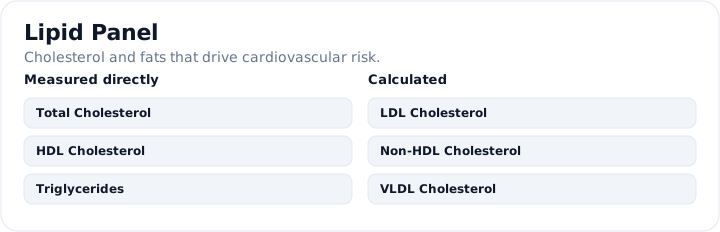
Your lipid panel reports 5–7 numbers. Most people check LDL and stop. Here's the right reading order, the ratios labs don't calculate, and when a "high" LDL actually requires context to interpret correctly.
A lipid panel is four numbers. Each answers a different question about your cardiovascular risk.
ACC/AHA categories. For people with cardiovascular disease or diabetes, the treatment target is below 70 mg/dL — stricter than the general population.
Low HDL is an independent cardiovascular risk factor under ACC/AHA guidelines. The sex difference matters — a value of 48 mg/dL is acceptable for men but suboptimal for women.
AHA categories. Triglycerides are the most diet-responsive marker on the panel — fasting state matters. A non-fasting sample inflates the number. Results above 500 mg/dL need prompt medical review.
Don't act on total cholesterol alone. A total of 210 mg/dL with HDL of 75 mg/dL is a different picture than total of 210 mg/dL with HDL of 38 mg/dL. Always read total alongside HDL.
Two derived values carry more predictive weight than individual marker levels — and neither appears on a standard printout.
Non-HDL = total cholesterol minus HDL. It captures all atherogenic particles — LDL, VLDL, IDL, and Lp(a) — in a single number. ACC/AHA considers non-HDL a better cardiovascular risk predictor than LDL alone, particularly in people with high triglycerides. Target: below 130 mg/dL. Above 160 mg/dL warrants the same attention as LDL above 160 mg/dL.
Calculate it: [Total Cholesterol] − [HDL] = Non-HDL
Divide your triglycerides by your HDL. This ratio is not reported by labs. It's one of the strongest accessible markers of insulin resistance and small dense LDL particle pattern — the particle type most associated with arterial plaque formation. It's also one of the seven markers behind the term metabolic optimization, alongside fasting insulin, HbA1c, and hs-CRP.
| TG/HDL ratio | Interpretation |
|---|---|
| <2.0 | Favourable — low insulin resistance signal |
| 2.0–3.0 | Borderline — worth monitoring alongside fasting insulin and glucose |
| 3.0–5.0 | Elevated — consistent with early insulin resistance even if fasting glucose is normal |
| >5.0 | High — strong insulin resistance signal, elevated cardiovascular risk |
Calculate it: [Triglycerides] ÷ [HDL] = TG/HDL ratio, or use the cholesterol ratio calculator, which also handles mmol/L. A ratio above 3.0 (in mg/dL) paired with fasting glucose above 90 mg/dL warrants a fasting insulin test to confirm or rule out insulin resistance.
LDL is the most overinterpreted number on a lipid panel. The same value carries different clinical weight depending on the surrounding picture.
ACC/AHA guidelines do not treat LDL in isolation. Their 10-year ASCVD risk calculator uses LDL alongside age, sex, total cholesterol, HDL, systolic blood pressure, diabetes status, smoking, and blood pressure treatment status to estimate cardiovascular event risk. That percentage — not the LDL number alone — determines whether medication is appropriate.
An LDL of 145 mg/dL in a 35-year-old woman with high HDL, normal triglycerides, no diabetes, no smoking, and no family history of early heart disease carries far lower 10-year risk than an LDL of 145 mg/dL in a 55-year-old man with low HDL, elevated triglycerides, and borderline blood pressure.
Three factors that raise the urgency of any LDL reading: a family history of premature cardiovascular disease (first-degree relative before age 55 in men, 65 in women), a TG/HDL ratio above 3.0 (suggesting small dense LDL pattern), and a high-sensitivity CRP above 2 mg/L (confirming arterial inflammation).
Knowing what each value means is step one. Knowing which to address first given your full panel is step two.
Free. No account. Works with any lab report in 45 seconds.
Upload My Report →